
What actually happens at a hearing assessment at hear.
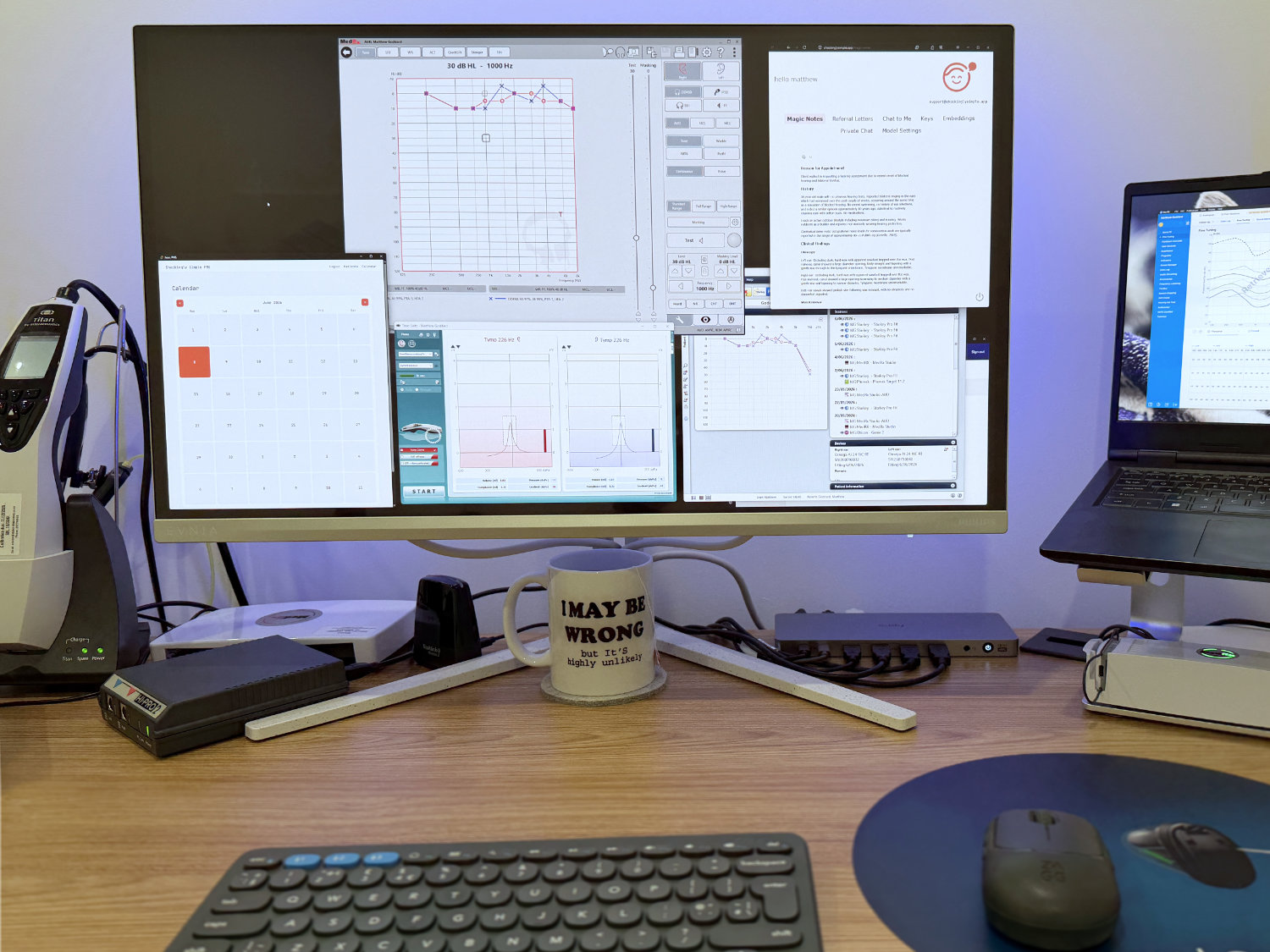
Most people who book their first hearing assessment have a quiet question they haven't quite asked out loud: what does a hearing assessment to involve? The short answer is that it takes about an hour, it is not uncomfortable, and by the end of it you will understand your hearing in a way you probably haven't before.
Before you arrive, you will have already filled in a short intake form as part of the booking process. Part of that form is a modified version of a hearing handicap inventory - a brief set of questions about how hearing is affecting your daily life. It means we can get straight to the conversation when you arrive, and everything that follows has context behind it.
In clinic
When you sit down, we talk about what brought you in. Some people come because a family member suggested it. Some have noticed things slipping gradually and want to know where they stand. Some have tinnitus that has started to feel less manageable. Whatever your reason, the questions I ask come from what you tell me. It is your time, and the appointment takes its shape from you.
Inside your ears
Once I have a clear picture of your history, we move into the assessment. The first step is otoscopy - a direct look into the ear canal. It tells me whether the canal is clear, whether the eardrum looks as it should, and whether anything needs attention before we go further. I will describe what I see; some people find this genuinely interesting.
Eardrum movements, reflex pathways
After otoscopy comes tympanometry, which measures how the eardrum and middle ear system move (to transmit sound).
It takes about five seconds per ear. My equipment automatically follows this with acoustic reflex testing. Kind of like the equivalent of a tendon hammer knee-jerk test except for ears (there's a tiny muscle in the middle ear that twitches to sound). Together, these give a picture of how the mechanical side of hearing is working as well as the nerve pathway from the ear to the brainstem and back again (reflex test).
The "Hearing Test"
Hearing threshold testing comes next - the part most people recognise, where you listen through headphones and respond to tones. The test runs across a range of frequencies in each ear, with bone conduction added where needed to determine whether any loss is sensorineural, conductive, or mixed. That distinction shapes what comes next.
Speech discrimination follows immediately - how clearly you can repeat back words at a comfortable listening level. After that, QuickSIN: a standardised test of how well you follow speech in background noise. This is often where the most clinically relevant findings sit, because the audiogram alone does not always tell the full story of how a person is coping in real-world listening environments. Where QuickSIN raises questions, I will sometimes run an ACT test as well, which looks at temporal fine structure processing and does not depend on language skills.
Your understanding of the results
Then we go through the results. The aim is for everything to connect - the test findings, your history, the kinds of situations you described finding difficult. Most people leave with a clearer picture of their hearing than they have ever had. The questions people ask at this point are usually the most useful part of the whole appointment.
What comes next?
Whether hearing aids come into the conversation depends entirely on what you want. If you are wondering whether they would help, I will bring you back to the reasons you came in and ask you directly. If it is not the right time, or you simply want to know where you stand and return later, that is a completely reasonable outcome. A follow-up assessment every one to two years is typical for most people.
The booking link is at the top of the page. New patients use the intake form; returning patients book straight through without it. Any questions, call the clinic if that's easier: (03) 281 8781. See you in the clinic. - Matthew